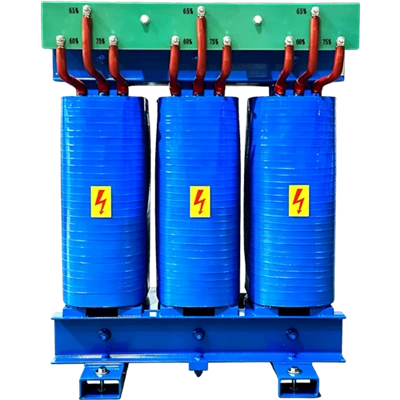


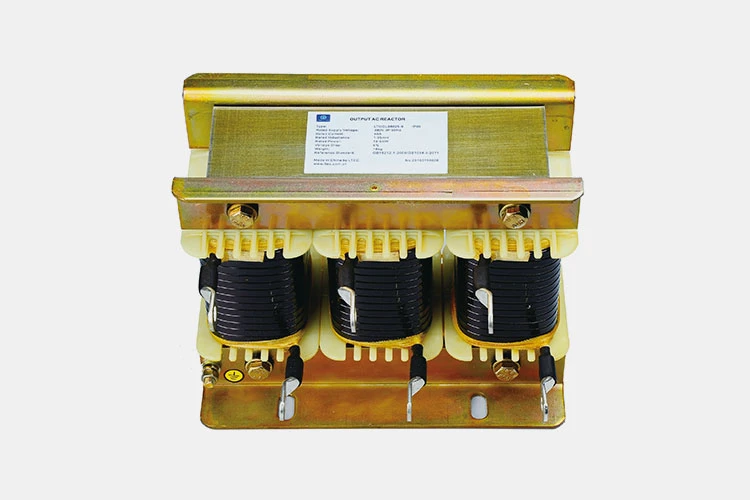
A line reactor can help on the supply side of your VFD-but what about the cable and motor on the other side?
If your motor is some distance from the drive, or you are upgrading an existing installation, you may be wondering whether a load reactor would be a useful addition. You may also have come across dv/dt filters and sine wave filters, making the choice less straightforward.
The right starting point is your application: the drive, the motor, the cable connecting them, and the problem you want to prevent or resolve. Let's look at where a load reactor fits, when it is worth considering, and when another solution may be a better match.
1. What Is a Load Reactor for a VFD?
A load reactor is an inductive component installed between your VFD and motor. You may also see it called an output reactor or output choke.
The connection is straightforward:
VFD → Load Reactor → Motor
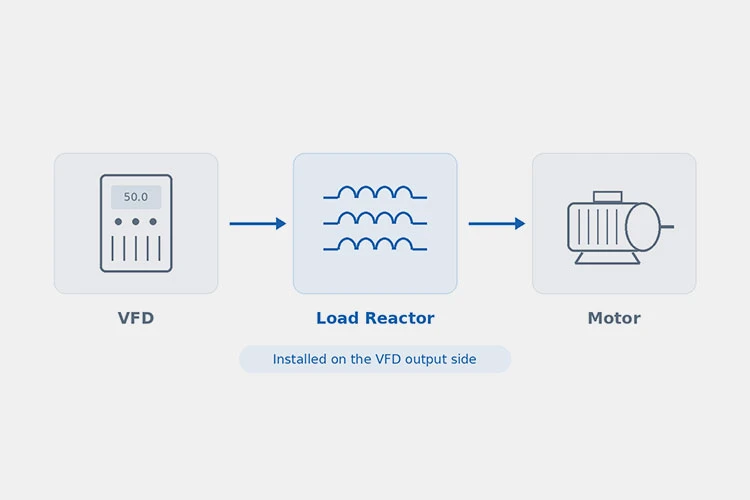
Its inductance opposes rapid changes in current, helping smooth some of the high-frequency current components associated with the drive's PWM output. The voltage reaching the motor, however, remains a pulsed waveform-a load reactor does not convert it into a sine wave.
If you already have an input line reactor, it is reasonable to ask whether you need another reactor on the output. They serve different parts of the installation: the input reactor works on the supply side, while the load reactor works between the drive and motor.
Whether your motor circuit needs one depends on the equipment and cable arrangement. The first step is to check the VFD manufacturer's output-side recommendations.
For a closer look at how input and output reactors differ, see our guide to line reactors vs. load reactors.
2. What Does a Load Reactor Do?
A correctly selected load reactor can help improve motor-side operating conditions in three ways:
Smoother motor current. Its added inductance helps reduce high-frequency current ripple associated with the VFD's PWM output.
Potentially less noise and heating. Reducing these current components may lower switching-related motor noise and additional losses. Results depend on your drive, motor, and operating conditions.
Support for longer cable runs. A suitable reactor can help limit cable-charging current, but it does not guarantee adequate protection against reflected-wave voltage peaks.
If your main concern is motor insulation, a dv/dt filter or sine wave filter may be more appropriate. Start with the problem you need to solve, then check the equipment manufacturer's recommendations.
3. When Should You Consider a Load Reactor?
You do not need to add a load reactor simply because your motor runs on a VFD. It is worth reviewing in these situations:
- Your motor is far from the drive. Check the VFD manufacturer's cable-length limits and recommended output components.
- You are upgrading an existing motor to VFD operation. Confirm that its insulation is suitable for PWM power, particularly with longer cables.
- You notice switching-related noise or unexpected heating. Investigate the cause first; a reactor may help, but cooling, loading, and drive settings also matter.
- The drive manufacturer recommends one. Follow the specified reactor characteristics and installation requirements.
There is no universal cable length at which every installation needs a reactor. The right choice depends on your drive, motor, cable, and operating conditions.
4. Load Reactor, dv/dt Filter, or Sine Wave Filter?
If you are comparing these options, start with the result your motor needs.
| Main purpose | Key consideration | |
| Load reactor | Adds inductance to smooth current and help limit cable-charging current | Motor-terminal voltage peak protection is limited and application-dependent |
| dv/dt filter | Slows voltage pulse edges and limits peaks within its specified operating range | The motor still receives a PWM voltage waveform |
| Sine wave filter | Produces a near-sinusoidal phase-to-phase output voltage | Must match the drive's switching frequency, output frequency, and load |
For a longer cable run or an older motor, a load reactor alone may not provide the protection you need. Ask your supplier to check the complete drive–cable–motor arrangement before choosing.
5. How to Select a Load Reactor for Your VFD
You do not need to calculate every parameter yourself. Start by sharing these details with your supplier:
- Motor rated current and overload duty: These help determine the required current capacity.
- VFD model and output voltage: The reactor must be suitable for the drive's PWM output.
- Output frequency range and switching frequency: Both affect reactor performance and heating.
- Motor cable length and type: Include any parallel cable runs or multiple motors.
- Installation conditions: Specify ambient temperature, altitude, enclosure space, and ventilation.
Ask the supplier to confirm inductance, voltage drop, and thermal performance for your operating conditions. Selecting a reactor based only on motor power may overlook important application details.
If you are replacing an existing unit, share its nameplate and explain why it needs replacing.
Conclusion:
A load reactor can be a useful addition when it addresses a clear need in your motor circuit. Start with your drive, motor, cable arrangement, and the problem you want to solve.
For some installations, a suitable reactor is enough. Others need a dv/dt filter or sine wave filter to meet the motor's insulation requirements.
Need Help Choosing a Load Reactor?
Share your VFD model, motor current, and cable length with LTREACTOR. Our team can help you review a suitable option for your application.
Get Selection Support
Frequently Asked Questions
1. Are load reactors and output reactors the same?
In VFD applications, both terms generally describe a reactor installed between the drive and motor. Always confirm that the selected unit is rated for PWM output operation.
2. Do I need a load reactor if I already have an input reactor?
Possibly. An input reactor serves the supply side and does not replace output-side protection. Assess the motor circuit separately using the drive manufacturer's recommendations.
3. Can a load reactor eliminate motor bearing currents?
A standard three-phase load reactor is not a dedicated bearing-current solution. Bearing protection may require measures such as common-mode filtering, shaft grounding, or insulated bearings, depending on the cause.
4. Where should a load reactor be installed?
It connects between the VFD output and the motor, usually near the drive. Follow the reactor and VFD manufacturers' instructions for placement, wiring, grounding, and ventilation.
5. Can one load reactor serve several motors?
Some arrangements allow a shared reactor, but selection requires reviewing the combined current, cable branches, and drive compatibility. Each motor also needs appropriate overload protection. Confirm the arrangement with your equipment supplier.